
1.2.1What if the function is in pieces?
Piecewise-Defined Functions and Continuity
When working with your team to solve problems in this course, it is important to work effectively with other people. Effective math conversations are a valuable part of the learning process throughout this course. Choose a member of your team to read the Collaborative Learning Expectations out loud.
COLLABORATIVE LEARNING EXPECTATIONS
Working with other students allows you to develop new ways of thinking about mathematics, helps you to learn to communicate about math, and helps you to understand ideas better by having to explain your thinking to others. The following expectations will help you get the most out of working together.
An effective, participating team member will:
|

On the same set of axes, graph the functions
What happens to the graph at
? When we combine parts of several functions to make a single function, we call it a piecewise-defined function. Just as the graphs can be drawn on the same set of axes, the algebraic functions of
and can be “pieced together” as a single function. This function can be written as . Evaluate , , and ). If using a TI calculator or Digital Graphing Calculator, follow the links to view video instructions for inputting piecewise-defined functions.

Intuitive Notion of Continuity
The formal definition of continuity will be given in Chapter 2. For now, we can say that a function is continuous if the graph of the function can be drawn without lifting your pencil from the paper.
The graph of a continuous function is shown at right. The equation of this piecewise-defined function is:
The graph is continuous at

When the values of a function are not connected as in problem 1-11, we say that the function is not continuous. The function
.png)
It is important to note that polynomial, rational, power, exponential, logarithmic, and trigonometric functions are continuous at all points in their domains.
Examine the graph of the function
In your own words, explain why
is continuous at . Explain why
can also be defined as . Sort the following functions into the categories listed below:
, , , (the greatest integer function), , , , , , , ,
Category I: Continuous for all real values of.
Category II: Continuous on its domain only.
Category III: Discontinuous on its domain.
Domain and Range Notation
There are two accepted forms of notation for domain and range. Examine the graph at right. The domain and range of the function shown can be noted in either interval notation or in set notation.
Interval Notation:
Set Notation:

Explain why the two forms of set notation for the domain in the preceding Math Notes box are equivalent.
Compare the domains of
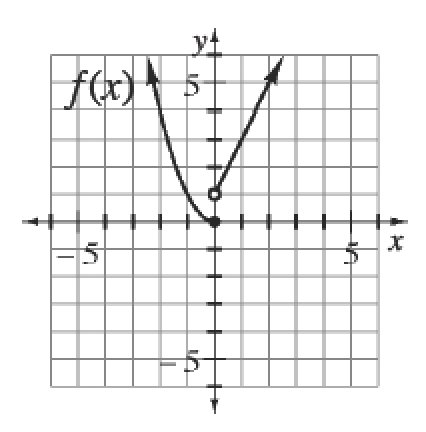
Given

.png)
.png)
State the domain and range of
. At what value of
is the original function discontinuous? At what value of
is discontinuous? What about ? Explain the different answers.
There is a debate among mathematicians over whether
Write
as a piecewise-defined function. Write
as an absolute value function. Why do you think this issue is debatable?
Let
Sketch the graph of
. Modify one piece of the function so that it is continuous.
Determine values of
Selected values of a continuous function are shown in the table below.
If the graph of
has one unique minimum point, where do you think this point is? Explain your thinking. Could the graph of
be a parabola? If so, write a possible equation for . If not, explain why not. Could the graph of
be an absolute value function? If so, write a possible equation for . If not, explain why not. Is it possible that
? Explain. Is it possible that
has a vertical asymptote at ? Explain.

Let
Sketch the graph of
. Is this function continuous? Shade the area between
and the -axis. What is the shaded area? g is an example of a step function. Why do you think it is called a step function?
Given the functions below, compute the following values Homework Help ✎
Calculate , , and . Calculate , , and . Calculate , , , and . Sketch a graph of
.
In order to mail a letter in the United States, postage must be paid based on the weight of the letter. Although rates are tied to the number of ounces, the U.S. Post Office does not allow for payments of partial ounces.
A graph showing the postage rates for letters weighing fewer than
.png)
How much would you pay for a letter weighing
ounces? For ounces? For ounces? Write a piecewise-defined function that determines the postage rates for letters weighing between
and ounces. Let represent the weight in ounces, and represent cost in dollars.
A semi-circular flag is shown attached to a “pole” at right. Homework Help ✎

Imagine rotating the flag about its pole and describe the resulting three-dimensional figure. Draw a picture of this figure on your paper. To help you visualize this, use the 1-23 HW eToo.
Calculate the volume of the rotated flag.
Sketch a graph of the piecewise-defined function
State the domain and range of
. Is
continuous at ? Explain. Is
continuous for all values of ?
The parabola
Use the combined area of these trapezoids to approximate the area under the parabola for
. Is this area greater or less than the true area under the parabola? Explain.
.png)
What is the exact value of each of the following trig expressions? Homework Help ✎
Sketch the graph of
Why does this graph have a vertical asymptote? What is the equation of that asymptote?
State the equation of the horizontal asymptote.
Alter the equation y =
so that the vertical asymptote is and the horizontal asymptote is .
Polynomial Division with Remainder
The examples below show two methods for dividing. Both have remainders which are written as fractions.
Using long division:
Final answer:
Using an area model:
2 by 5 generic rectangle | top edge first | top edge second | top edge third | top edge fourth | top edge fifthRemainder |
left edge top | interior top first | interior top second | interior top third | interior top fourth | interior top fifth |
left edge bottom | interior bottom first | interior bottom second | interior bottom third | interior bottom fourth | interior bottom fifth blank |
Answer: | |||||
Use polynomial division to rewrite each of the following rational expressions. Homework Help ✎